

.png)


.png)


Rev. Jesse Louis Jackson: The Legacy and Impact.

Updated: Jul 25
Reverend Jesse Louis Jackson (8th October 1941 – 17th February 2026)
Rev. Jesse Louis Jackson stands as one of the most influential figures in the American civil rights movement. His work spans decades of activism, political engagement, and community leadership. Jackson’s efforts helped shape the fight for racial equality and social justice in the United States. This post explores his legacy, highlighting key moments and contributions that continue to inspire new generations.
Early Life and Entry into Activism
Born October 8, 1941, in Greenville, South Carolina, to Helen Burns and Noah Louis Robinson. He was raised largely by his mother and stepfather, Charles Henry Jackson.
He attended the University of Illinois on a football scholarship before transferring to North Carolina Agricultural and Technical State University, where he became student body president and a star quarterback.
Jesse Jackson grew up during a time of intense racial segregation and discrimination. His early experiences with injustice fuelled his passion for change. After attending the University of Illinois and later North Carolina A&T State University, Jackson became involved with the Southern Christian Leadership Conference (SCLC), led by Dr Martin Luther King Jr.
Jackson’s role as a field organiser and later as a national coordinator for the SCLC placed him at the heart of the civil rights movement. He participated in key campaigns such as the Selma to Montgomery marches and worked tirelessly to register African American voters in the South. His ability to connect with communities and organise grassroots efforts made him a vital force in the struggle for civil rights.
Civil Rights Career He became deeply involved in the civil rights movement in the 1960s, working closely with Dr Martin Luther King Jr and the Southern Christian Leadership Conference (SCLC). He was present at the Lorraine Motel in Memphis when King was assassinated in 1968 — a moment that deeply shaped him.
Video credit: @justthatcoollike
Political Leadership and Presidential Campaigns
Rev. Jesse Louis Jackson expanded his influence beyond activism by entering the political arena. In 1984 and 1988, he ran for the Democratic presidential nomination, becoming the first African American to mount a serious campaign for the presidency. His campaigns broke barriers and brought issues affecting African Americans and marginalised communities to the national stage.
Jackson’s presidential bids emphasised economic justice, education reform, and an end to systemic racism. Although he did not secure the nomination, his campaigns energised voters and helped diversify the political conversation. His efforts paved the way for future African American candidates and increased political participation among minority groups.
Advocacy for Economic and Social Justice
Throughout his career, Jackson has championed causes beyond voting rights. He founded Operation Breadbasket and later Operation PUSH (People United to Serve Humanity) in 1971, focusing on economic empowerment for Black Americans. In 1984, he founded the National Rainbow Coalition, which later merged with PUSH to form the Rainbow/PUSH Coalition. These groups focus on economic empowerment, education, and social justice.
Jackson’s work includes advocating for fair employment practices, affordable housing, and improved healthcare access. He has negotiated with corporations and government officials to increase opportunities for minorities and underprivileged communities. His approach combines activism with practical solutions aimed at reducing inequality.
International Human Rights Efforts
Rev. Jesse Louis Jackson’s impact extends beyond the United States. He has been involved in international diplomacy and human rights advocacy. Jackson has travelled to countries such as South Africa during apartheid, advocating for the release of political prisoners and supporting anti-apartheid movements.
His global efforts highlight the interconnectedness of civil rights struggles worldwide. Jackson’s work helped raise awareness and build international pressure against oppressive regimes. This global perspective enriched his approach to activism and reinforced the importance of solidarity across borders.
Jackson conducted several high-profile diplomatic missions, negotiating the release of hostages and prisoners in Syria (1983), Cuba, Kosovo, and other conflict zones—often acting independently of the U.S. government.
Challenges and Controversies
Like many public figures, Jackson’s career has faced challenges and controversies. Critics have questioned some of his political decisions and leadership style. Despite this, his commitment to civil rights and social justice remains clear.
Jackson’s ability to adapt and continue advocating for change over decades demonstrates resilience. His willingness to engage with diverse communities and address complex issues has kept him relevant in evolving social and political landscapes.
Controversies: Jackson faced criticism over his 1984 reference to New York City as "Hymietown," an antisemitic remark he later apologised for. He also had a publicised extramarital affair that produced a child, revealed in 2001. His relationship with Nation of Islam leader Louis Farrakhan drew criticism as well.
Later Life and Health In 2017, he announced he had been diagnosed with Parkinson's disease. He has gradually stepped back from public life as his health has declined. His son, Jesse Jackson Jr., served as a U.S. congressman but later faced legal troubles and served prison time for misuse of campaign funds.
Continuing Influence and Inspiration
Rev. Jesse Louis Jackson’s legacy is visible in many areas of American society today. His work helped dismantle legal segregation and inspired movements for equality in education, employment, and political representation. Leaders who followed often cite Jackson as a key influence.
A towering figure in American political and civil rights history. He expanded the boundaries of what was considered possible for Black political candidates, mentored generations of activists, and kept economic and racial justice issues at the forefront of Democratic politics for decades. His famous phrase "Keep Hope Alive" became a rallying cry of the 1988 campaign and beyond.
For those interested in civil rights, Jackson’s life offers lessons in courage, persistence, and the power of collective action. His story encourages ongoing efforts to address racial and social injustices that persist.
Reverend Jesse Jackson recited the 'I Am Somebody' poem in February 1972. The powerful speech, delivered with a group of children on the stoop of 123 West 58th Street in Chicago, became a defining moment in the civil rights movement. It was later adopted by his organisation, PUSH (People United to Save Humanity), as a motivational tool for youth empowerment and self-worth. The poem emphasised dignity, identity, and collective strength, resonating widely across communities. Although often associated with broader activism, its origins trace back to this grassroots moment in early 1972.
I am… Somebody—Jesse Jackson
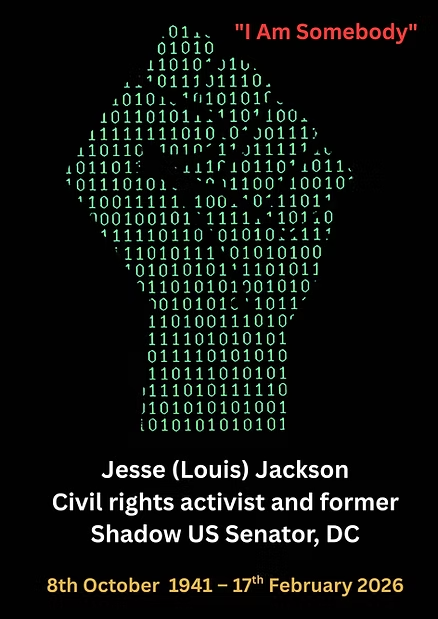
I am somebody!
I am somebody!
I may be poor,
But I am somebody.
I may be young,
But I am somebody.
I may be on welfare.
But I am somebody.
I may be small,
But I am somebody.
I may have made mistakes.
But I am somebody.
My clothes are different.
My face is different.
My hair is different.
But I am somebody.
I am Black.
Brown or white.
I speak a different language
But I must be respected.
Protected,
Never rejected.
I am God’s child!
Video Credit: @SesameStreetClassics
What Is the Impact of Jesse Jackson Now? (His Legacy Today)
Jesse Jackson passed away at age 84. His death triggered widespread reflection on the current significance of his work.
1. Central Bridge Between Movements and Generations
Leaders describe Jackson as a bridge from King-era civil rights to modern racial‑justice, voting‑rights, and anti‑racism movements.
Rev. Al Sharpton said: “From Martin Luther King to Barack Obama, there’s a bridge called Jesse Jackson.” usnews.com
2. A Model for Modern Political Organizing
Jackson’s approach to coalition politics continues to shape the Democratic Party and progressive organising today.
His multiracial, cross-class organizing model influences current political leaders and activists. thehill.com
3. Influence on Black Political Power and Representation
Historians argue the U.S. would not have seen a Black president as early as 2008 without Jackson's groundwork.
His runs normalised Black leadership in national politics and expanded minority engagement in elections.[thetriibe.com], [politico.com]
4. Legacy in Communities Across the U.S.
5. Continued Relevance in the Fight for Equity and Justice
Today, his legacy is invoked in ongoing struggles for:
Voting rights
Economic justice
Anti-apartheid and global human rights
Police reform
Educational equality
Scholars and activists stress that honoring Jackson requires “intensifying the struggle for racial and economic justice" (truthout.org).
6. Moral & Inspirational Legacy
Jackson is remembered not only as a political figure but also as a moral compass, shaping how activists see their duty today—daily, persistent work toward justice and inclusion. pbs.org
In Summary
His Impact Was:
A leading civil-rights strategist and King protégé
A pioneer who expanded voting rights and economic justice
A transformational presidential candidate who reshaped American politics
A diplomatic negotiator for international peace
A creator of multiracial coalition politics
A cultural icon whose words inspired generations
His Impact Is Now:
A guiding blueprint for today’s civil-rights and political movements
A foundational pillar in the rise of Black political leadership
A continuing influence on voting-rights activism
A symbol of hope, dignity, and the power of collective action
A moral standard-bearer for justice in the 21st century
Overview of Rev. Jackson's Life
1941—Early Life Jesse Louis Jackson, born Jesse Burns on 8 October 1941 in Greenville, South Carolina, rose from student activist to one of the most influential figures in American civil rights history. As a young man studying at North Carolina A&T in the early 1960s, he threw himself into the movement through sit-ins, demonstrations, and the landmark Selma to Montgomery march of 1965.
1966–1968—Operation Breadbasket: Martin Luther King Jr recognised his talent early, tapping him to lead Operation Breadbasket's Chicago branch in 1966 and elevating him to national director the following year. Under his leadership, the organisation wielded economic boycotts as leverage against white-owned businesses, pushing them to hire Black workers and patronise Black-owned firms. After King's assassination in 1968, Jackson remained a central voice in the struggle, eventually founding Operation PUSH in Chicago – an organisation dedicated to economic justice and holding corporations accountable to Black communities.
1984–1988—Presidential Campaigns His ambitions extended into electoral politics in the 1980s, when he mounted two serious bids for the Democratic presidential nomination. His campaigns in 1984 and 1988 were built on a "rainbow coalition" of Black Americans, Latinos, poor whites, and other marginalised groups, and they fundamentally altered the landscape of American politics—helping pave the way for future candidates, most notably Barack Obama.
2000s onwards—Legacy Well into the 21st century, Jackson remained a recognisable moral force, championing voting rights, economic justice, and anti-apartheid causes while also serving as an informal international mediator. He is widely regarded as one of the primary torchbearers of the Civil Rights Movement's legacy.
Additional Resources:
Parkinson's Disease (UK Support)
UK Equality Act 2010
Bibliography in alphabetical order by author/organisation:
Addison, G. (ed.) (1971) The Black Aesthetic. New York: Doubleday.
American Community Media (2026) 'How Jesse Jackson kept hope alive for Black youth', American Community Media, 16 February. Available at: https://americancommunitymedia.org/news-exchange/how-jesse-jackson-kept-hope-alive-for-black-youth/
BBC News (2026) 'Jesse Jackson: How he paved way for Barack Obama', BBC News, 17 February. Available at: https://www.bbc.co.uk/news/articles/cx77214zz9eo
Chicago History Museum (2023) 'Jesse Jackson's Operation PUSH', Google Arts & Culture. Available at: https://artsandculture.google.com/story/jesse-jackson-39-s-operation-push-chicago-history-museum/zQVRbo2RdayVbQ
Encyclopaedia Britannica (2025) 'Jesse Jackson | Biography, civil rights, accomplishments, & facts', Encyclopaedia Britannica, 27 October. Available at: https://www.britannica.com/biography/Jesse-Jackson
In These Times (2020) 'Before Bernie, there was Jesse', In These Times, 16 August. Available at: https://inthesetimes.com/article/jesse-jackson-black-hope-progressive-campaign
Jackson, J. (1987) Straight from the Heart. [with R.D. Hatch and F.E. Watkins, eds].
Jackson, J. and Jackson, J.L. Jr (1995) Legal Lynching: Racism, Injustice, and the Death Penalty.
Jeffries, H. (2017) 'Reconsidering Jesse Jackson: The caricature, the person, the politician (Part 3)', African American Intellectual History Society (AAIHS). Available at: https://www.aaihs.org/reconsidering-jesse-jackson-the-caricature-the-person-the-politician-part-3/
Politico – Jesse Jackson, civil rights activist and presidential candidate, dies at 84 https://www.politico.com/news/2026/02/17/jesse-jackson-activist-candidate-civil-rights-409480
PBS – The Rev. Jesse Jackson, leader of Civil Rights Movement for decades, dies at 84 https://www.pbs.org/newshour/politics/the-rev-jesse-jackson-leader-of-civil-rights-movement-for-decades-dies-at-84
Tennessean (USA Today Network) – Civil rights to modern voting, Jesse Jackson's influence in Nashville https://www.tennessean.com/story/news/local/2026/02/17/nashville-tennessee-rev-jesse-jackson-dead-civil-rights-sit-in/88716065007/
The Hill – Jesse Jackson’s legacy resonates as political world grapples with his death https://thehill.com/homenews/campaign/5742419-jesse-jackson-legacy-black-politics/
The TRiiBE – Rev. Jesse Jackson left a lasting impact on civil rights and political possibilities for Black America https://thetriibe.com/2026/02/rev-jesse-jackson-left-a-lasting-impact-on-civil-rights-and-political-possibilities-for-black-america/
Truthout – Jesse Jackson’s Legacy Spans from Civil Rights Movement to Anti‑Apartheid Fight https://truthout.org/video/jesse-jacksons-legacy-spans-from-civil-rights-movement-to-anti-apartheid-fight/
witnessed-martin-luther-king-jrs-assassination-heres-how-he
Study.com (2022) 'Jesse Jackson: Life, civil rights & political activism', Study.com, 23 March. Available at: https://study.com/academy/lesson/jesse-jackson-life-career-children.html
Walters, R.W. (1988) Jesse Jackson's 1984 Presidential Campaign: Challenges and Contributions.
WANE News – Fort Wayne leaders remember Rev. Jesse Jackson’s legacy, local ties https://www.wane.com/top-stories/fort-wayne-leaders-remember-rev-jesse-jacksons-legacy-local-ties/
Wikipedia (no date) 'Jesse Jackson', Wikipedia. Available at: https://en.wikipedia.org/wiki/Jesse_Jackson
WXYZ Detroit – Civil rights icon Rev. Jesse Jackson remembered in Detroit as being ‘bigger than life’
Yahoo News (via KOLR Springfield) – Civil Rights leader Jesse Jackson remembered in Springfield
https://www.yahoo.com/news/articles/civil-rights-leader-jesse-jackson-020019174.html
YouTube (2019) 'Jesse Jackson on the legacy of Martin Luther King's dream', YouTube video, 20 January. Available at: https://www.youtube.com/watch?v=RgzzKFMqSQY


Comments